Station House Awards · buyer guide
Proofing firefighter service dates and roles
For worldwide Station House Awards orders, label the firefighter’s role and each service period by what they actually describe. Department service, station assignment, retirement and presentation dates can differ. Ask the authorized reviewer to approve their meaning before refining abbreviations or calculating any tenure total for the finished recognition gift.
Reviewed 2026-09-05 · AI-assisted editorial review. General buying guidance; illustrative scenarios are not customer case studies. Images are AI-generated concepts.
A recipient may have held several roles during a career, and the title familiar to colleagues may differ from the title intended for the occasion. Ask the authorized department contact which role should appear and how it should be written. Do not infer the current or retirement role from an old photograph, a station nickname or a previous plaque. If the organizer wants to recognize a particular assignment, label that scope clearly. The gift can include an approved role without reproducing every position held. A concise, accurate identification is preferable to a crowded list that nobody has checked as a complete historical statement. Keep the final display title separate from background notes used to explain the request.
DIY Awards offers firefighter retirement plaque designs.
Sources: DIY Awards: Crystal Retirement Plaques for Firefighters
How do you separate department service from a specific assignment?
A date range can describe total department service, years at one station, time in a particular role or a volunteer period. Ask which meaning the organizer intends and label it in the working record. Do not combine overlapping periods or calculate a credited total from raw dates without an approved result from the responsible owner.
A statement about service at one station should not visually imply a complete career chronology. If both are important, consider separate labeled lines and review whether the added information helps the recipient understand the tribute. The designer’s job is to reproduce an authorized statement, not interpret personnel rules or decide which periods qualify for recognition.


How do you keep retirement and presentation dates distinct?
The date of a ceremony may differ from the date the recipient retires from the role. Decide which, if either, belongs on the physical piece. A presentation date can be useful when it is clearly identified, while an unexplained date beneath a retirement heading may be interpreted as the actual retirement date.
If the ceremony moves, review any dated wording before release. Consider an approved year-only or undated appreciation message when the exact event date is still provisional, but do not change the scope silently. Keep the original date meaning in the worksheet so a later replacement does not substitute the reorder date. The final text should remain accurate after the event schedule is forgotten.
How do you review volunteer and career terminology carefully?
A department may use particular terms for volunteer, part-time, career or other service relationships. Ask the authorized contact to supply the wording appropriate to the recipient and the intended recognition. Do not choose a label based on a product template or assume that different service relationships can be combined under one numerical phrase.
If the organizer wants to thank someone for several kinds of contribution, a carefully approved appreciation statement may communicate that without making an ambiguous tenure claim. The recipient’s role history remains the department’s responsibility. Production needs the approved inscription fields and their meaning, not a personnel file containing details that should never appear on the gift.
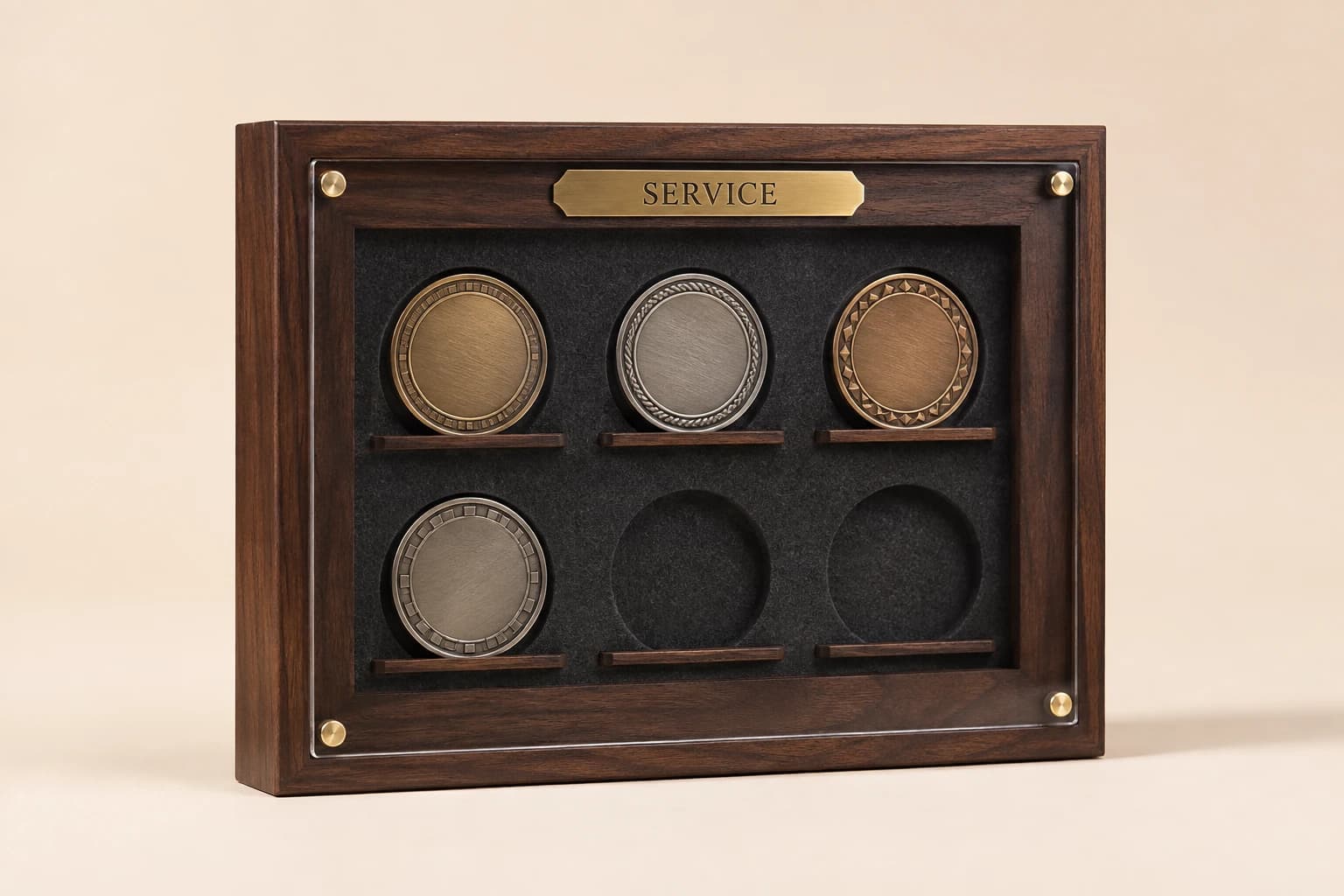
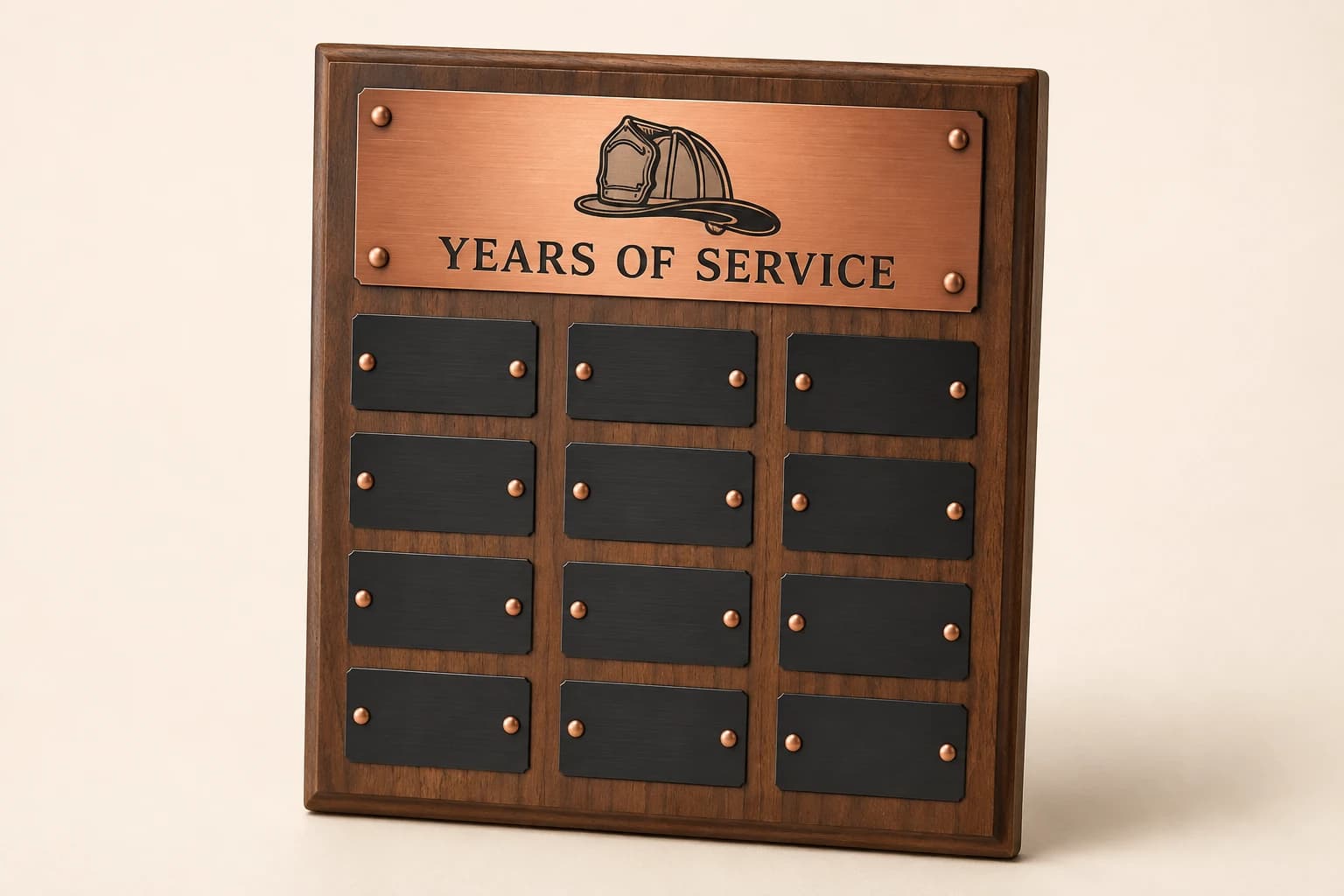
How do you read the complete role-and-date statement aloud?
Show the reviewer the actual proposed layout and ask what it says in ordinary language. This can reveal that a date range appears to modify the wrong role or that a station number seems part of a title. Review punctuation, abbreviations and line breaks together.
If a compact role name is proposed to save space, have the department approve that exact form. A text counter can flag a long line but cannot decide whether an abbreviation remains clear to the intended audience. Keep the recipient’s name visually identifiable and avoid giving an uncertain service total the largest position simply because it looks impressive. The hierarchy should support the approved meaning.
Check the station-service inscription fields
Load the fictional example, then replace its inputs with the reviewed details for your project.
Method: Count visible characters including spaces and punctuation on each entered line; compare each length with the user-entered line budget. Text counts do not establish physical fit.
Build your plan
Counts include spaces and punctuation. Character count cannot establish physical fit: font, script, layout, material and engraving area require a proof at actual size.
Use the article’s example files
Sample rows are illustrative and are not production instructions. Replace their assumptions, keep private records separately and complete the approval fields before using the sheet for a real order.
How do you keep appreciation separate from official achievement claims?
A retirement or service gift can express the presenting group’s gratitude without asserting a specific commendation, incident outcome or performance record. If an official achievement is intended, ask the appropriate department owner to supply the authorized wording and confirm that it belongs on this object.
Do not expand a simple role-and-date line into claims of exceptional bravery or life-saving results because a sample uses those phrases. A personal gift from colleagues and a department-issued award may require different attribution. Make that distinction clear in the proof. The organizer should be able to explain who is speaking and which statements are verified facts versus a sincere expression of thanks.

How do you check the finished inscription against the released fields?
At receiving, compare the name, role, date labels and appreciation statement with the final proof. Read the whole inscription rather than checking only the recipient’s surname. If a correction is needed, identify the exact field and proof revision. Preserve the earlier release record and issue a new approved version rather than overwriting the history of what was ordered.
For later replacements, reproduce the historical role and occasion unless the authorized contact deliberately requests a correction. A recipient’s later activities or a changed department naming convention do not automatically alter the original gift. This keeps the physical tribute faithful to the approved recognition rather than turning every reorder into an unreviewed rewrite.
How do you resolve a role change within the displayed period?
Suppose a fictional recipient served at one station for a long period but held the final role for only part of it. A heading showing that role above the whole date range could be read as claiming the person held it throughout.
Ask the reviewer whether the title identifies the recipient at retirement or describes the period below. A clear label such as station service can preserve the intended distinction, while separate role dates may be appropriate if the organizer wants that detail. Do not let line placement decide the historical interpretation accidentally. The reviewer should approve the complete relationship of name, role and dates before the designer treats the composition as final.
How does this illustrative text proof work?
For a fictional text proof, the organizer uses Firefighter Alex Morgan, Station 4 Service and 2010–2026 on three lines. These are invented example fields, and the date range is explicitly described as fictional station service rather than a complete career.
The text counter checks the line lengths while the worksheet reserves approval of the role and date meaning for the authorized department reviewer. The fictional lines Firefighter Alex Morgan, Station 4 Service and 2010–2026 contain 23, seventeen and nine characters respectively, counting spaces and the date separator. The total is 49 across three lines, with a longest line of 23. Each is within the chosen 24-character budget. The worksheet explicitly labels the range as station service and leaves real approval on hold. A line within the budget is not evidence that the role, dates or physical engraving layout are correct.
Labeled service period or Appreciation without a tenure total: which fits the intended recognition?
A labeled service period states the approved role or assignment associated with the dates. Appreciation without a tenure total can thank the recipient while an uncertain chronology stays out of the inscription. Compare what each complete statement asserts, and avoid turning a station-service range into an unverified claim about an entire career.
| Option | Labeled service period | Appreciation without a tenure total |
|---|---|---|
| Best reason to choose it | Choose this when the authorized department owner has confirmed the scope and exact display wording of the dates. | Choose this when gratitude is the purpose and a numerical service statement is unnecessary or unresolved. |
| Main review question | Does the range describe the department, station, role or another clearly identified period? | Does the message honor the intended contribution without implying an unverified period or official award? |
| What to specify | Supply the approved role, date labels and complete service statement as one reviewed inscription. | Specify the preferred name, occasion and presenting group with any optional approved date kept clearly labeled. |
| Later change | A corrected assignment range should retain its explicit role label and the reviewer’s approved interpretation. | An added tenure total is a new factual claim that requires authorization beyond the prior appreciation wording. |
What should the organizer confirm before ordering?
Approve the meaning of the role and each date before adding a service total. Station assignments, department service and a presentation day can tell different stories. The text proof should keep those distinctions visible, allowing appreciation to remain accurate even when the organizer chooses to omit an unresolved chronology.
How do service-date questions affect price and timing?
Ask Station House Awards to quote the selected piece, personalization, artwork and shipping with its applicable minimum or range. Resolve the role and date interpretation before releasing the inscription. A ready design does not settle an uncertain tenure statement, so the schedule should include the department reviewer’s approval of the complete text rather than a spelling check alone.
Can several date ranges be added into one service total?
Have the authorized department reviewer approve any total instead of asking the engraver to add ranges. Overlaps, breaks and different types of service can change what that number means. A labeled period or appreciation message can remain clear without an unverified career total while the underlying chronology is being resolved.
Should the retirement date equal the ceremony date?
Keep them separate unless the reviewer confirms they are the same event date for this inscription. A ceremony can occur before or after the formal role transition. Label the chosen date by its meaning so future readers do not infer that a presentation day establishes the person’s final day of service.
What if the person changed roles during the displayed period?
Decide whether the wording describes the broader approved service period or a particular assignment. A single title beside a long range can imply that the person held that role throughout. Ask the reviewer to approve a clearer label or separate fields instead of using the shortest title because it fits the design.
What does the Station 4 text example establish?
The fictional lines name Firefighter Alex Morgan, Station 4 Service and 2010–2026. The range is an invented station-service field, not a verified career history. The checker measures line lengths only. Replace the role, name and dates with approved project wording, retaining the distinction between assignment service and any wider department tenure.
Sources and scope
The sources below support the cited technical details. The ordering workflows are editorial recommendations. Your project specification, price and schedule are established in the written quote and approved proof.
- DIY Awards: Crystal Retirement Plaques for Firefighters · checked 2026-09-05
Which buying guide should you read next?
All buying guidesFor worldwide Station House Awards orders, choose a retirement gift for the individual’s take-home appreciation and a station board entry for a continuing institutional record. Their wording, ownership and later-update rules differ. If the ceremony includes both, count two physical pieces per approved pair and release separate proofs for their respective uses.
For worldwide Station House Awards orders, match a replacement nameplate to the identified existing board or holder, using written measurements and the approved text hierarchy. Confirm whether the request corrects wording, replaces damage or adds an entry. The physical interface and visual match need separate review before several plates share one specification.